
- Key Takeaways
- Steering Mechanics and Wear Factors
- Common Symptoms of Front-End Play
- Steering and Kingpin Play Inspection
- Front-End Alignment Dynamics
- Pre-CVIP Compliance Verification
- Professional Front-End Solutions
- Conclusion
- Frequently Asked Questions
- What is steering and kingpin play?
- What are common symptoms of steering or kingpin play?
- How is steering and kingpin play checked during an inspection?
- Can steering and kingpin play affect wheel alignment?
- Why is front-end play important for CVIP or similar inspections?
- How often should steering and kingpins be inspected?
- When should I see a professional for front-end play?
Key Takeaways
- Steering and kingpin play occurs when pivot points, bearings and linkages wear, so frequent inspections and lubrication keep steering precise and minimize safety hazards. Implement a regular maintenance schedule where you check kingpins, bushings, tie-rod ends and drag links for any looseness.
- Heavy loads, rough roads and high mileage are especially hard on front-end wear, particularly at kingpins, bushings and steering joints. Monitor load history, running routes and miles driven to estimate when inspections and part replacements may be due.
- Steering wander, wheel oscillation and tread feathering are all classic warning signs of steering or alignment problems, not just kingpin problems. Educate drivers to spot and report these signs early so mechanics can investigate before breakdowns.
- A genuine steering and kingpin play inspection involves unloading the axle, measuring with the correct tools, isolating each joint, and inspecting linkages and bearings for damage or excessive play. Go through a standardized checklist and document everything to help justify repair decisions and compliance.
- Checking front-end alignment, component play, and lubrication within manufacturer and CVIP tolerance limits ensures inspection failure and downtime surprises don’t occur. Maintain measurements, alignment settings, and repairs in a pre-CVIP documented process.
- Working with a professional heavy truck repair provider that knows steering, kingpin play and CVIP standards means being safer, having less repeated issues and passing more often! Fleet managers can take advantage of continuous inspection programs, clear repair criteria, and driver training assistance.
Steering and kingpin play is the free movement or looseness in the steering system and the kingpin joints of a vehicle’s front suspension. In practical terms, it appears as excess play in the steering wheel prior to engaging the wheels turning or as a loose, wandering sensation behind the wheel. Numerous road safety checks and inspections include steering and kingpin play as checking points, as worn parts in this location can increase stopping distance and reduce stability. On trucks, buses, and old-school kingpin-based vehicles, excessive play can point to worn bushings, pins, or linkages. The following passages discuss causes, symptoms, test procedures, and basic repair alternatives in plain, straightforward language.
Steering Mechanics and Wear Factors
 Steering play stems from the general front-end system and not just the kingpins. The steering wheel input passes through the steering gear, drag link, tie-rod ends and kingpins into the steering knuckles and then the wheels. Minor play in any joint cumulatively adds up, so even tight kingpins can feel loose if tie-rod ends or drag link joints are worn.
Kingpins are hardened steel pins connecting the steering knuckle to the axle on numerous heavy-duty and semi-trucks. They serve as the primary pivot so that the wheel and brake assembly can swivel under intense loads. Bushings, thrust bearings, and wheel bearings hold up that pivot, distribute the load, and keep the wheel at the proper angle to the road. When these components are tight and properly lubricated, the front wheels track true, return to center with ease, and maintain alignment.
Wheel bearings, suspension arms, spring pins, and all steering joints combat toe, camber, and caster. Wear at the kingpin or steering knuckle support can shift caster and camber and then manifests as pull, drift, or uneven tire wear. Having all these pieces inspected and serviced regularly is a safety move and it is crucial for CVIP compliance and cost control.
Pivot Points
Kingpins and their bushings are the main pivot points that allow the front wheels to turn during steering. Steering knuckle supports may be like a straight axle, where the knuckle slides over the support and the kingpin bushings sit in the knuckle. The function is the same: carry load and allow smooth rotation with minimal play.
Wear at these pivots causes looseness, which manifests as steering play, wandering, shimmy or brake pull. Typically, if a kingpin exhibits more than roughly one-eighth of an inch (3 mm) of movement in a lift-and-check test, it is deemed worn and should be replaced.
A quick kingpin play test is to jack the front axle so both wheels are off the ground, then rock each wheel top and bottom while observing the kingpin area. If there is any obvious up-and-down or in-and-out play at the pivot, that’s a red flag, not something to watch “later.
Basic pivot‑point checklist for inspections:
- Test vertical and horizontal play at each kingpin with wheels raised. Gauge or measure against a maximum of 1/8 inch.
- Check for play at tie-rod ends, drag link ends, and steering gear pitman arm.
- Check bushings and thrust bearings for metal-on-metal contact, rust streaks, or crushed shims.
- Assure steering knuckle support surfaces are unscored, uncracked, and undeformed.
- Document results, plan kingpin replacement on high-mileage machines frequently reaching 350,000 to 700,000 miles plus load and conditions.
Disregarding kingpin looseness places strain on other steering and suspension components and frequently manifests initially as cupped or feathered tires, along with increased maintenance expenses over time.
Load Dynamics
Heavy loads transfer extra stress into the front during braking and slow turns, which accelerates wear on kingpins, bushings, wheel bearings, and steering joints. Rough roads, speed bumps hit a little too fast, and deep potholes send sharp impacts through the axle and steering knuckles that can crack bushings, dent bearing races, or bend minor components long before they outright break. Your high-mileage truck drives this load history right into every joint, so repeated cycles creep clearances ever larger, even when individual impacts seem benign. Tracking average payload, typical routes and road quality allows us to predict which units might hit the kingpin replacement window earlier and lets shops schedule work before steering play becomes a safety concern. Proper trailer maintenance also helps fleets stay ahead of wear across equipment that operates under demanding loads and road conditions.
Lubrication Gaps
Bad grease is one of the quickest ways to wear out kingpins, bushings, and steering joints. Without a continuous grease film, friction increases, heat accumulates, and hardened pins can begin to score bushings and thrust surfaces.
Dry, old, or contaminated grease may cause binding, resulting in stiff steering or sudden jumps as the joint breaks free, which can conceal initial play until the damage is severe. We glue the kingpins to the box, apply anti-corrosion, grease, and use better materials and manufacturing techniques.
A transparent lube schedule encompassing all steering and suspension grease points, supported by documentation, allows fleets to associate overlooked intervals with subsequent breakdowns. Report dry, squeaky, or notchy steering right away, as these minor symptoms are often your first indication of a lubrication gap.
Common Symptoms of Front-End Play
Front-end play presents initially as changes in steering and front tire wear, long before obvious failure. Drivers and technicians can often spot trouble early by observing small but consistent patterns in steering response, wheel behavior, and tread wear.
Key warning signs of excessive front-end play include:
- Loose, unresponsive, or “sloppy” steering wheel feel
- Need for frequent steering corrections to stay in lane
- Drift or pull that varies with road speed or load.
- Shimmy, shake, or oscillation through the steering wheel
- Cupping or scalloping on the edges of front tires
- Rapid wear on one side of the tire tread
- Excessive inner or outer wear bands on front tires
- Steering play often shows up as noticeable movement in tie rods, drag links, or kingpins upon turning the wheel.
- Clunking from the front axle over bumps or when turning.
Having play in steering components on the bike, or even during a turn-in-place test, typically indicates wear in kingpins, bushings, or joints. A simple kingpin play test, with the front axle jacked so the wheels hang free, allows an inspector to measure vertical and horizontal play. More than approximately 0.120 inch (approximately 1/8 inch) of kingpin play is a typical out-of-service limit on heavy trucks. That wear occurs in the steering kingpin at the front-axle assembly and in a trailer kingpin where it interfaces with the fifth wheel, but either can lead to unstable handling if neglected.
Struggle to maintain a straight line aren’t necessarily a kingpin issue—it could be caused by misalignment, loose wheel bearings, or inconsistent tire pressure. Since a given symptom can have multiple causes, drivers assist the diagnosis by noting what they feel, when it occurs, and how often it repeats. Logging and reporting those symptoms early facilitates prompt inspection, prevents steering failure and potential DOT violations, and reduces the risk of unscheduled downtime.
Steering Wander
Steering wander is when the vehicle wants to drive off a straight line, so the driver is always making small or even continuous steering inputs to keep in the lane. It can feel like the wheel never “centers,” or like there’s a lag between hand movement and vehicle response. A loose, unresponsive, or sloppy steering wheel is typically one of the first indicators that kingpins, tie-rod ends, or other steering joints are no longer keeping the geometry taut.
Worn kingpins let the steering knuckle slip under load, while loose tie-rod ends and drag links permit unwanted toe changes as the vehicle rolls. Misaligned suspension parts or uneven ride height can contribute to this, meaning the car might drift more at certain speeds or when cargo is on board. Drivers should watch out when they find themselves making more corrections than usual or when a slight crosswind or road crown makes the car feel difficult to keep on a straight line.
For practical tracking, drivers can log when wander shows up: road type (straight highway, curves, urban streets), surface condition (dry, wet, rough), and typical speed range in kilometers per hour. This type of record assists service personnel in determining whether the issue relates more to velocity, load or particular courses, which directs them toward kingpin wear, alignment checks or steering linkage inspection.
Wheel Oscillation
Wheel oscillation is a shimmy or shaking that comes through the steering wheel, usually within a speed range. It may begin as a mild vibration and build into a violent shake that requires a death grip on the steering wheel, fading again as speed fluctuates. Sometimes, it appears after a bump, then gradually winks out.
It’s usually related to loose or worn steering joints, unbalanced or out-of-round wheels, damaged or soft bushings, or excessive kingpin play that lets the wheel “hunt.” Cupping or scalloping on the tire edges can both come from and feed back into this oscillation, as the uneven tread slaps the road in a cyclical fashion. Over time, the cycle accelerates tire wear and places additional stress on springs, shocks, and steering components.
When safe, an assistant can observe the front wheels as the vehicle is stopped and the steering turned left and right. Any exposed lateral play of the wheel or knuckle, instead of a pure pivot, indicates play in the kingpin or connection. During workshop inspections with the front axle raised, even minor side-to-side shaking can reveal looseness that is not evident on the road.
| Oscillation trait | Typical range / note |
|---|---|
| Frequency | From slow side‑to‑side sway to rapid shimmy |
| Speed range | Often 40–70 km/h, may vary by vehicle |
| Severity levels | Light vibration, moderate shake, heavy shimmy |
Tread Feathering
Tread feathering is an uneven wear pattern where the tread blocks are sharp on one side and smooth on the other, creating a sawtooth effect across the tire. If you feather your hand across the tread, it will feel smooth in one direction and gritty in the other. It may manifest on just one tire or both front tires depending on the nature of the misadjusted geometry.
This behavior typically indicates misalignment, worn kingpins that allow the wheel to change angle under load, or loose front-end components that move toe and camber as you drive. Worn suspension components, loose or worn tie rods, and misaligned or bent spindles can all create symptoms that resemble wheel bearing or hub damage. If the car continues to operate in this state, accelerated wear on one side of the tread is imminent and tire life can plummet.
Drivers and operators can mitigate risk by inspecting front tires according to a schedule, by sight and by feel. Looking straight at the tread and along the shoulder makes feathering and cupping easier to identify. When odd wear shows up, it helps to record tire position, axle, roughly how many kilometers since the last rotation, and any associated steering symptoms such as wander or shimmy.
These observations belong in service records, even if the tire remains above legal tread depth. When a technician combines this information with measured kingpin play, alignment readings and joint inspection, it is much simpler to determine if front-end components require adjustment or complete replacement.
Steering and Kingpin Play Inspection
Our expert steering and kingpin play inspection minimizes steering failures, CVIP and DOT headaches, and unplanned downtime for both tractors and trailers.
- Park on level ground, chock rear wheels, and set the parking brake.
- Unloose the steer axle so both front wheels dangle.
- Steering and Kingpin Play Inspect the steering wheel free play and linkage while an assistant turns the wheel.
- Check for steering and kingpin play.
- Check for play in the steering and at the kingpins.
- Separate each joint to discover the precise origin of the looseness.
- Inspect bearings, seals, boots, hardware, and lubrication points.
- Record results, compare to limits, and schedule needed repairs.
1. Unload Axle
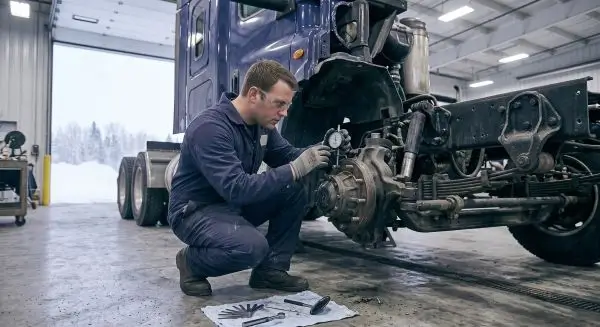
Unloading the axle is to lift the front of the vehicle until both steer tires are off the ground, so the suspension and steering dangle with no load. This step is important because weight on the tires can conceal looseness in kingpins, bearings, and linkages that only manifest when the axle is unburdened. Use certified jacks and stands rated above axle weight, set on solid ground, and never work under a truck supported only by a jack.
Once the axle is unloaded, grab each tire at the 12 and 6 o’clock positions and rock it top to bottom for a quick kingpin play inspection. If you notice or sense more than approximately 0.120 inch (around 1/8 inch) play, the kingpins are probably worn out. Document how the axle feels and looks before and after lifting, and then make note of any additional play that presents itself once the wheels are airborne.
2. Measure Movement
 Utilize dial indicators, pry bars or feeler gauges to detect play at kingpins, tie-rods, drag links, and spring or steering bushings. Numerous heavy-truck standards consider approximately 0.120 inches as a reasonable maximum for kingpin play. Adhere to the specific tolerances in the manufacturer specifications for the equipment you’re servicing.
Note down each reading per side and per joint, then highlight any that are beyond limits or feel borderline. A plain table, organized by axle and component, helps facilitate explaining repair requirements and comparing outcomes at the next 90-day inspection.
3. Isolate Joints
Move one steering component at a time to isolate each joint as we want to get them all covered. Have an assistant slowly turn the steering wheel left and right. Observe a single joint or linkage and see if it moves in conjunction with the rest.
Look for free play, lag, or a ‘snap’ as the joint takes up clearance. Any slop in a single tie-rod end, drag link end, or kingpin bushing can accumulate to vague steering or lane wander on the road.
This habit puts you ahead of the curve by identifying parts that require replacement prior to a CVIP instead of following a failed inspection.
4. Check Linkages
GENERAL MAINTENANCE: Inspect all steering linkages such as drag links, pitman arms, idler arms, and tie-rod ends for looseness or bent or cracked sections. Inspect for torn or cracked dust boots, missing cotter pins, loose castle nuts, and heavy corrosion around studs or clamps.
Steering & Kingpin Play Inspection – Utilize a torque wrench to verify critical fasteners are at specified torque, such as steering arms and clamp bolts on adjustable tie-rods. Worn linkage components should be replaced and re-torqued prior to CVIP to prevent out of service results related to steering safety.
5. Inspect Bearings
Spin each front wheel and sense for roughness, grinding, or rumble that suggests worn wheel bearings. Then verify end play with a dial indicator as you push and pull on the tire. Check seals for oil or grease leaks and evidence of dirt or water ingress.
Worn kingpin bearings add steering play, generate heat, and may induce cupping or ‘scalloping’ at the tire edges or accelerated tread wear on one side. If necessary, replace faulty bearings immediately and recheck adjustment so end play remains within spec.
Frequent kingpin and bearing inspections every 90 days, along with greasing kingpins every 10,000 to 15,000 miles, assist in reducing wear in the front-axle kingpin area and in trailer kingpins where they mate with the fifth wheel. In the case of a kingpin with more than 1/8 inch of movement or a failed fifth wheel lock or kingpin, inspectors will put the unit out of service. A failed lock can result in trailer separation with significant safety and cost implications.
Front-End Alignment Dynamics

Front-end alignment maintains the steering balance and the tires wear in a consistent, even manner. When caster, camber, and toe are in the proper range, the steering wheel is rock solid, your truck will track unerringly straight, and both front tires take an equal load. This reduces feathering, cupping, and edge wear, so tread life matches the service schedule and unplanned downtime remains minimal.
Steering movement relies on loose pivots at both the top and bottom of the steering knuckle. That is why front ends use one of three pivot systems: kingpins, trunnions, or ball joints. In a kingpin setup, wear and contamination accumulate. Dry bushings and thrust bearings, loose or worn bushings, and failed seals all come back to bite you as play and rough steering feel. That kingpin wear can drive load to one side of the joint and cause uneven steering component pressure, harsh coupling, or even an upper coupler failure. Bad lubrication, grit working past seals, and long service under heavy loads all accelerate this type of damage.
Spring selection influences alignment stability. Front suspensions employ leaf springs, coil springs, or torsion bars. Leaf spring systems are simple and robust; they don’t hold the wheel as precisely as coil or torsion setups, so delicate handling and precise wheel control are tougher to maintain. Like any spring, over time it sags, wheel travel compresses, and the original spring rate diminishes. A front end that now sits a few millimeters lower can alter caster and camber just enough to manifest as pull or edge wear, even though the steering linkage may still be in good condition.
When you’re doing an alignment check, it’s not sufficient to just ‘set toe and go’. Caster, camber, and toe are all checked, recorded, and adjusted to spec. The Ackermann theory comes into play: lines drawn through the steering knuckles and tie-rod ends should meet at the center of the differential when the steering arms sit behind the front wheel axis. This design allows the inner wheel to trace a smaller radius during a turn than the outer wheel, minimizing scrub and maintaining predictable traction during cornering. A ball joint system goes a long way here too, with its high-tensile bolt, large ball, and matching spherical cup that seats the bolt’s ball end. When ball joints are tight and free, they maintain the geometry under load without binding.
For any vehicle going out to a CVIP, record the alignment readings. Any caster, camber, or toe values that drift outside the allowed range should be fixed and reverified prior to inspection so the front end satisfies both safety regulations and everyday driving demands.
Pre-CVIP Compliance Verification
Pre-CVIP compliance verification ensures that steering, suspension, and kingpin components are already CVIP compliant prior to the inspection. It lowers failure risk, saves rebooking fees, and minimizes downtime. A good pre-CVIP encompasses the entire front end in addition to brakes, hitches, wheels, and tires, as these systems influence each other under load. Relying on a fixed checklist, not memory, makes the process more likely to stay consistent from one technician to another and from one site to another. Any defect discovered should be immediately remediated, not monitored, since a failed CVIP in Alberta or other Canadian provinces can translate to additional expense, postponements, and even vehicle impoundment.
Documenting each pre-CVIP check, repair, and recheck counts. These logs aid internal investigations, assist in monitoring wear trends over time, and provide evidence of diligence in the event of a road accident or compliance inspection.
Tolerance Limits
In Alberta, kingpin vertical and horizontal play can’t go beyond that allowed in the provincial CVIP manual. As a rough rule of thumb in lots of fleets, anything over roughly 1.0 mm of measured kingpin movement under load is considered a red flag. Tie-rod ends, drag links, and steering gear output shafts shall exhibit no visible looseness when inspected with a pry bar or dial gauge. Technicians must check play with wheels raised, brakes off, and steering unlocked, and then compare the readings to the published tolerance tables instead of ‘looks okay’ judgment. Any such unit above the limit must be decommissioned, even if the motorist hasn’t yet experienced symptoms of shoddy handling, as early play can bloom rapidly under intense traffic. Shops achieve speed and consistency by posting a quick reference chart at each bay of steering and kingpin limits for popular axle types, makes, and models, including front wheel bearings and suspension bushings.
Driver Protocols
Drivers facilitate pre-CVIP efforts via walk-around checks that target steering and suspension performance under actual use. A practical checklist may include: steering wheel free play, effort, and return to center; any knocks, clunks, or squeaks while turning at low speed; visible looseness at tie-rod ends and drag link joints; air or hydraulic leaks near the steering gear; uneven tire wear on steer tires; ride height or lean that hints at spring or suspension damage. These checks should form part of broader commercial carrier safety and maintenance programs.
Drivers should check in immediately if they experience looseness, wander, pull under braking, hard steering, or shudder while turning. They should report any new noises from the front axle, even if they appear minor. Each symptom requires a brief note in the logbook or electronic app, with the date, odometer, and general conditions, such as loaded or empty, highway or city.
Every few months, training sessions assist drivers in recognizing the first warning signs of front-end wear. These signs include a wheel that requires constant correction, a steering wheel that doesn’t return to center, or an inexplicable shift in tire wear. All are indicators of possible kingpin, linkage, or suspension issues.
Repair Criteria
Pre-CVIP results should translate into explicit guidelines about when to fix or replace steering and kingpin components. Any kingpin, tie-rod end, drag link, steering gear mount, or suspension component that exhibits play at or close to the provincial limit, visible cracking, rust bleed at joints, torn boots, or failed lubrication needs to be booked for immediate repair, not held over until the next annual check. Vehicles are taken out of service if there is steering play over the limit, if there is binding or “notchy” steering, or if components display structural damage that may cause loss of control.
In provinces like BC, SK, MB, and AB, where CVIP inspections are annual for most trucks and semi-annual for many buses that carry over 10 passengers in AB, early repair planning helps you avoid rush work and re-inspection fees, which frequently amount to between 100 and 200 CAD a visit. Several fleets use 3-month inspection intervals and include a front-end check after any significant work that can strain the chassis, including heavy off-road or collision repair work, to ensure vehicles are always prepped for the next CVIP.
Professional Front-End Solutions
Professional front-end solutions on heavy trucks is more than parts swapping. Which one is the kingpin of professional front-end solutions? Since the kingpin connects the front axle to the steering knuckle, its condition impacts steering feedback, tire wear, and safety. If there is too much play at the kingpin or in the steering linkage, drivers experience vague steering, pulling to one side, or require constant correction to stay in lane.
GRD Heavy Truck Repair offers this type of front-end services to fleets throughout Alberta, emphasizing steering and kingpin play. Their team checks for excessive movement at the steer axle, inspecting kingpins, tie rods, drag links and bushings as a system. We do a standard check by lifting the axle, using pry bars and dial indicators to see how far it moves and comparing that to safe limits. If a driver reports irregular tire wear, balky steering, or a CVIP close-call, GRD tailors those hints to identify worn or damaged components before they fail on the road.
A complete kingpin work isn’t an express repair. A pro front-end solution frequently requires specialty equipment, such as reamers, hydraulic presses, and line-boring equipment to seat new kingpins to spec. This type of work can cost anywhere from $500 to $1,500 or more per axle, depending on the truck, parts selection, and how much additional labor is required. When front-end care is deferred, that price can spike if the axle eye wears out and requires machine work or a complete axle replacement. GRD seeks to catch issues sooner via routine lubrication, scheduled inspections, and transparent logging that enable fleets to schedule work instead of responding to failures.
Fleet managers leveraging GRD for continuous front-end maintenance experience reduced roadside downtime and increased CVIP pass rates. In real terms, that means increased trucks on the road, reduced unexpected tire expenses, and more consistent budgeting.
Conclusion
Steering and kingpin play can sound like a minor thing, but it tells you volumes about front end health. Loose play in the wheel, weird tire wear, or pull on the road frequently indicates actual wear in components, not simply “old age” of the truck.
Clear checks help a bunch. Simple tests with the wheel, a bar under the tire, and a close look at pins, bushings, and links can flag most issues early. Throw in a little good alignment and some quality repair work, and that front end stays tight, safe, and CVIP legal.
For next steps, establish a set check routine, record your discoveries, and team up with a trusted shop before minor play becomes downtime or a failure at the bay.
Frequently Asked Questions
What is steering and kingpin play?
Steering and kingpin play refers to looseness in your front steering apparatus, particularly where your steering knuckle pivots. Too much play results in wandering, poor handling, and uneven tire wear. It’s a crucial safety issue and should be checked and fixed promptly.
What are common symptoms of steering or kingpin play?
Look out for loose steering feel, wandering, vibration, clunking noises, and uneven or quick tire wear. You might observe the car ‘pulling’ to one side, particularly when braking. Any of these signs indicate that an imminent front-end inspection is required.
How is steering and kingpin play checked during an inspection?
A technician lifts the front axle, supports it securely, and tests for play at the wheels with a pry bar and his hands. They measure play compared to manufacturer specifications. We inspect steering linkages, bushings, and kingpins for wear or damage.
Can steering and kingpin play affect wheel alignment?
Yes. Too much play keeps the front suspension from maintaining correct alignment angles. This causes bad tracking, high tire wear, and unsafe handling. Any worn parts should be fixed or replaced prior to final front-end alignment.
Why is front-end play important for CVIP or similar inspections?
CVIP and the like need tight steering parts to pass. Too much kingpin or steering play can cause you to fail inspection. Repairing worn components ahead of time helps prevent non-compliance, less downtime, and safer riding.
How often should steering and kingpins be inspected?
Check it as often as you can, depending on vehicle use, load and road conditions. A number of fleets incorporate front-end inspections into every service. For heavy or commercial vehicles, a thorough steering and kingpin inspection at least once a year is standard.
When should I see a professional for front-end play?
Find a pro immediately if you sense loose steering, clunking, or abnormal tire wear. Early diagnosis guards safety and lowers repair bills. A good mechanic can measure play, suggest fixes, and perform precise alignment.